The State of Tattoo Cover-Ups 2026
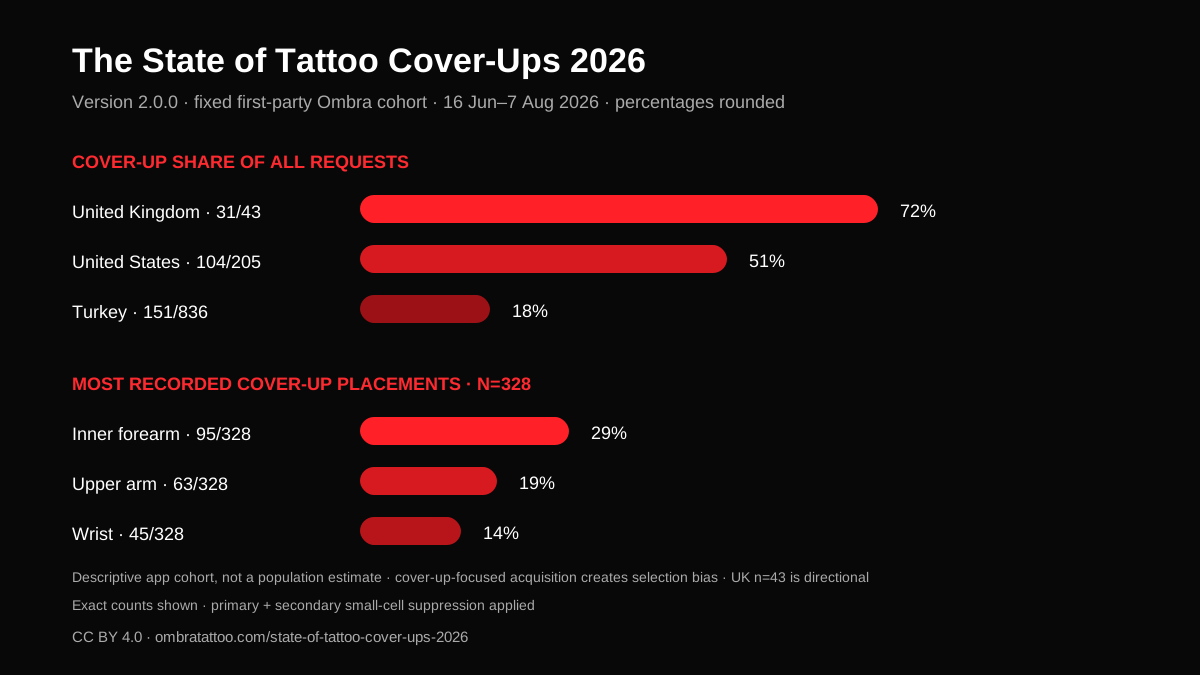
Within Ombra's fixed cohort, the observed cover-up share was 72% in the UK and 18% in Turkey. Among cover-up requests, inner forearm was the most recorded placement (29%), blackwork the most selected style (49%), and 86% used a black-based color approach. The lower-bound classifier found explicit name or lettering mentions in 17% of cover-up requests.
Updated
330 cover-up requests of 1,155 total designs · Version 2.0.0
Key findings
- 72%
of UK requests are cover-ups
31 of 43 UK requests in the fixed cohort, against 104 of 205 in the US and 151 of 836 in Turkey. Descriptive, not a population estimate.
- 29%
of cover-ups go on the inner forearm
The most-covered spot on the body, ahead of the upper arm (19%) and the wrist (14%).
- 49%
of cover-up designs are blackwork
Blackwork was selected for 160 of 328 requests with a usable style answer; 86% selected a black-based color approach.
- 60%
are a medium rework, not a blackout
Medium rework was selected for 198 of 328 usable scale answers, compared with 92 full-blackout and 38 small-touch-up answers.
Where cover-ups go on the body
Inner forearm was the most recorded placement in this cohort. Share of the 328 cover-up requests that recorded a placement — percentages are rounded to whole numbers, so they may not total exactly 100.
- Inner forearm(95 of 328)29%
- Upper arm(63 of 328)19%
- Wrist(45 of 328)14%
- Back(38 of 328)12%
- Chest(37 of 328)11%
- Calf(25 of 328)8%
- ShoulderSecondary suppression protects the adjacent n<10 cell
- AnkleInsufficient sample (n<10)
Cover-ups are a far bigger share of demand in the UK
Observed share of all tattoo design requests that are cover-ups, by country, inside this fixed Ombra cohort. The gap is descriptive: traffic mix, listing localization and other market-level factors may contribute. The UK figure rests on the smallest sample on this page and is directional rather than a population estimate.
- United Kingdom(31 of 43 (n=43 — small sample))72%
- United States(104 of 205)51%
- Turkey(151 of 836)18%
What people are covering
These shares come from what people wrote in their own words, so they are lower bounds: a name cover-up only counts here when the person described it as one, and the true shares are higher than the numbers below.
- A name or lettering(56 of 330)17%
- A tribal tattoo(32 of 330)10%
How cover-ups are designed
Blackwork was the most selected style in the recorded answers, and 86% selected a black-based color approach. These are planning preferences in Ombra requests, not evidence that one style will cover every tattoo.
- Blackwork(160 of 328)49%
- Realism(74 of 328)23%
- Neo-traditional(46 of 328)14%
- Geometric(27 of 328)8%
- Watercolor(21 of 328)6%
Color approach
- Black & white(150 of 328)46%
- Black & grey(131 of 328)40%
- Color(47 of 328)14%
Scale of the cover-up
Medium rework was the most selected scale in this cohort; full blackout and small touch-up were selected less often.
- Medium rework(198 of 328)60%
- Full blackout(92 of 328)28%
- Small touch-up(38 of 328)12%
The ten most requested cover-up symbols
- 1Moon42 requests
- 2Mountain33 requests
- 3Infinity32 requests
- 4Sun32 requests
- 5Wave32 requests
- 6Compass31 requests
- 7Star29 requests
- 8Arrow26 requests
- 9Wolf26 requests
- 10Rose22 requests
Methodology
Inclusion: every retained Ombra Creation row from 16 June 2026 at 09:18:22 UTC through the fixed extraction cutoff on 7 August 2026 at 14:30:04 UTC. The cohort contains 1,155 design requests, including 330 cover-up requests. Exclusion: records after the cutoff are not added to this report; two cover-up rows without a usable categorical answer are excluded only from placement, style, color and scale denominators, leaving n=328 for those dimensions.
Read the absolute shares with one caveat, which we would rather state than bury: Ombra's App Store listing is cover-up-focused, so the app attracts people who are already looking to cover something up. That inflates every absolute share here — this is not a measure of what share of all tattoos worldwide are cover-ups. Traffic mix, listing localization and other market-level factors may also affect the country shares. They are descriptive observations within this cohort, not causal or population estimates.
The “what people are covering” shares are derived from translated free-text descriptions using a fixed, case-insensitive keyword classification. Name or lettering includes explicit mentions of name, letter, text, word, initial or script; tribal includes explicit mentions of tribal. These are lower bounds: a category is counted only when the person stated it. The true shares are higher than the numbers printed here. Classification quality assurance reran the same rule over the fixed cohort and checked aggregate totals against the published cells.
The UK figure rests on 43 requests — the smallest sample on this page, marked inline wherever it appears. Treat it as directional rather than precise.
Percentages are rounded to the nearest whole number, so displayed shares may not sum to exactly 100. Exact numerators and denominators are published alongside them. This report does not calculate confidence intervals; that uncertainty, the directional UK sample and selection bias should travel with any citation.
Privacy: only aggregate categories are published. No user photograph, raw free-text response, account identifier or row-level record is included. Any cell with fewer than 10 observations is suppressed and shown as insufficient sample rather than exposing an exact count. A second placement cell is also suppressed so subtraction from the n=328 denominator cannot reveal the small cell.
Downloads, citation and reuse
Aggregate tables and charts are licensed CC BY 4.0. Credit Ombra Tattoo and link to the canonical report.
Ombra Tattoo. (2026). The State of Tattoo Cover-Ups 2026 (Version 2.0.0). https://ombratattoo.com/state-of-tattoo-cover-ups-2026
License: Creative Commons Attribution 4.0 International.
Questions, a breakdown for a specific market, or a figure you want checked before you print it — [email protected].
Version history
- Version 2.0.0 · 2026-08-09 — Corrected the observation start to the first retained row, fixed the extraction cutoff, added exact numerator/denominator fields, primary and secondary small-cell suppression, downloadable aggregate files, data dictionary, factsheet, chart, and CC BY 4.0 terms.
- Version 1.0.0 · 2026-08-07 — Initial public report with rounded shares and methodology limitations.
Written by Ombra Editorial Team · Editorial/data QA only · Specialist review not assigned
See a cover-up on your own tattoo
The cover-up findings above describe planning requests in Ombra's fixed cohort. Preview a new direction on a photo of your own tattoo, then ask a tattoo artist to confirm whether the placement, scale and ink density are feasible.
Try a cover-up in the app