Kintsugi Tattoo Ideas
Updated
The Ombra Tattoo team · Written by the Ombra product team — practical guidance for planning tattoo ideas, placement, and cover-up questions.
Kintsugi tattoo ideas adapt the visible repair seams of Japanese ceramics into body art. Porcelain hearts, tea bowls and fractured moons offer three different starting points. Choose the form and meaning that suit you, then work with an artist on color, detail and placement.
What does a kintsugi tattoo mean?
Kintsugi is a method of repairing ceramics with lacquer and a gold finish that leaves the joins visible. In the Smithsonian’s account of its Golden Seams exhibition, curator Louise Cort describes lacquer joining the pieces and powdered gold being sprinkled onto the seams. The craft concerns repaired objects; a tattoo adapts that visual language.
For your tattoo, the repaired form might represent a new chapter, a relationship you still value or simply a design you enjoy. These are possible personal interpretations, not a fixed Japanese symbol glossary or a promise that hardship makes someone stronger. You do not need to disclose a painful story to choose the aesthetic.
1. Porcelain heart: let the seams interrupt the pattern
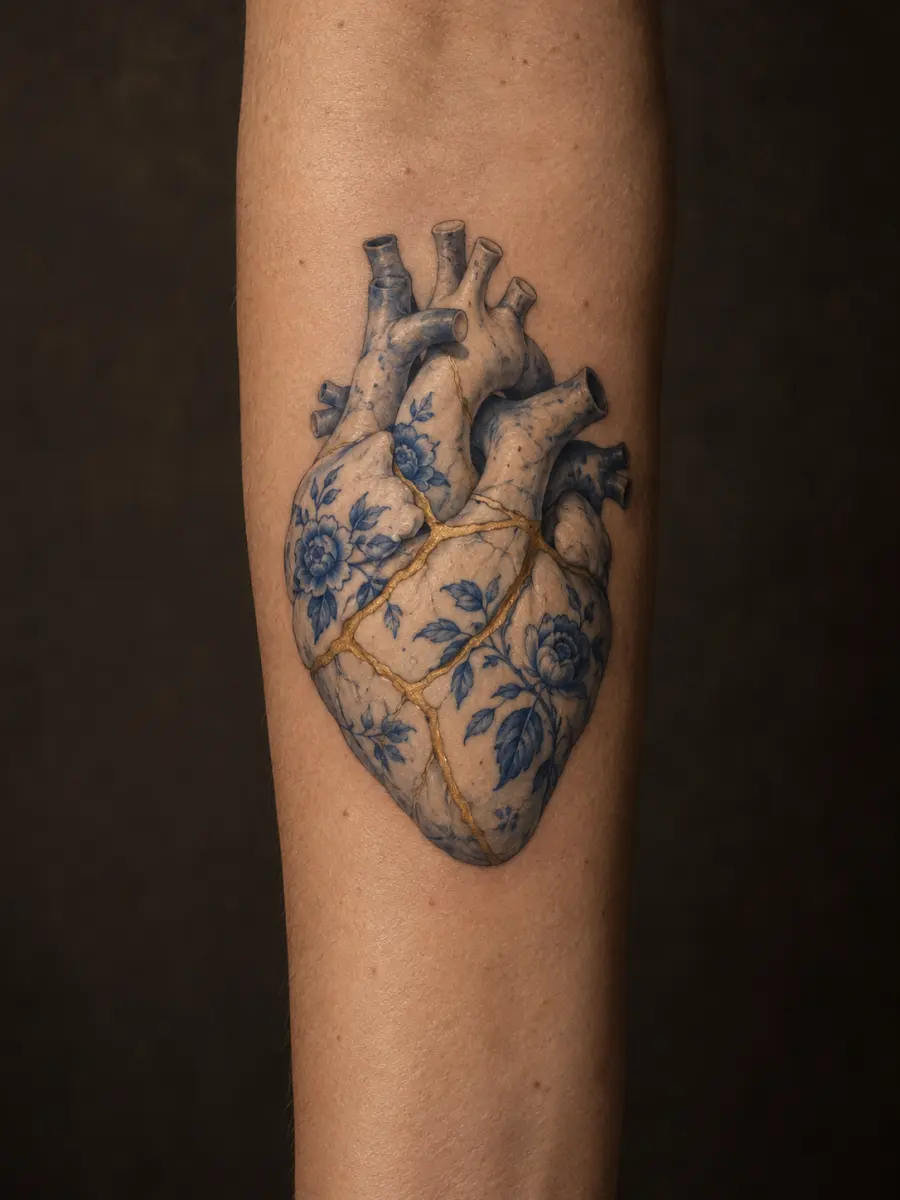
Choose an anatomical heart if you want an irregular silhouette with room for a ceramic pattern. Keep the main chambers recognizable. A few blue botanical marks can establish the porcelain illusion; the warm repair seams then cross that ornament rather than becoming another all-over pattern. Our concept uses this contrast to make the joins easy to find.
For a forearm placement, ask the artist which view should read when your arm rests naturally. If the design needs to be smaller, decide whether the blue ornament or the tiny vessel details can be simplified first. Do not assume all the details in a large image will work in a small stencil.
2. Repaired tea bowl: keep a familiar object readable
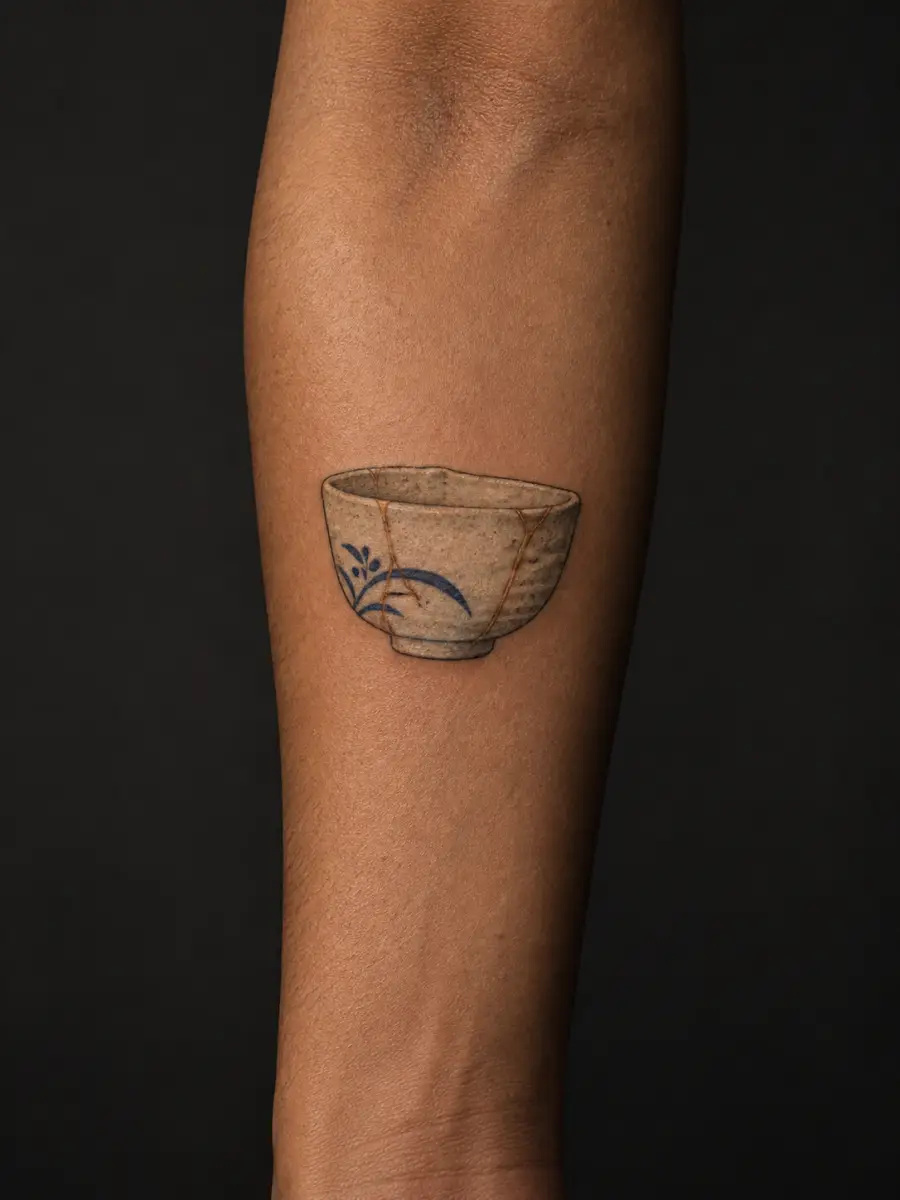
A tea bowl gives the repair a clear context. Start with a simple rim and curved base, then choose one or two places where the seam interrupts the outline. Leave some of the ceramic surface quiet. If every area contains flowers, cracks and highlights, the repair can become difficult to distinguish.
This is a useful direction when the object itself matters: a family cup, a daily ritual or a vessel that reminds you of home. Describe the shape and feeling of that object to an artist instead of copying an existing tattoo. For an inner forearm, compare the drawing with the arm relaxed and turned; a bowl that looks round in one photo may read differently from the side.
3. Blackwork moon: use contrast instead of porcelain ornament
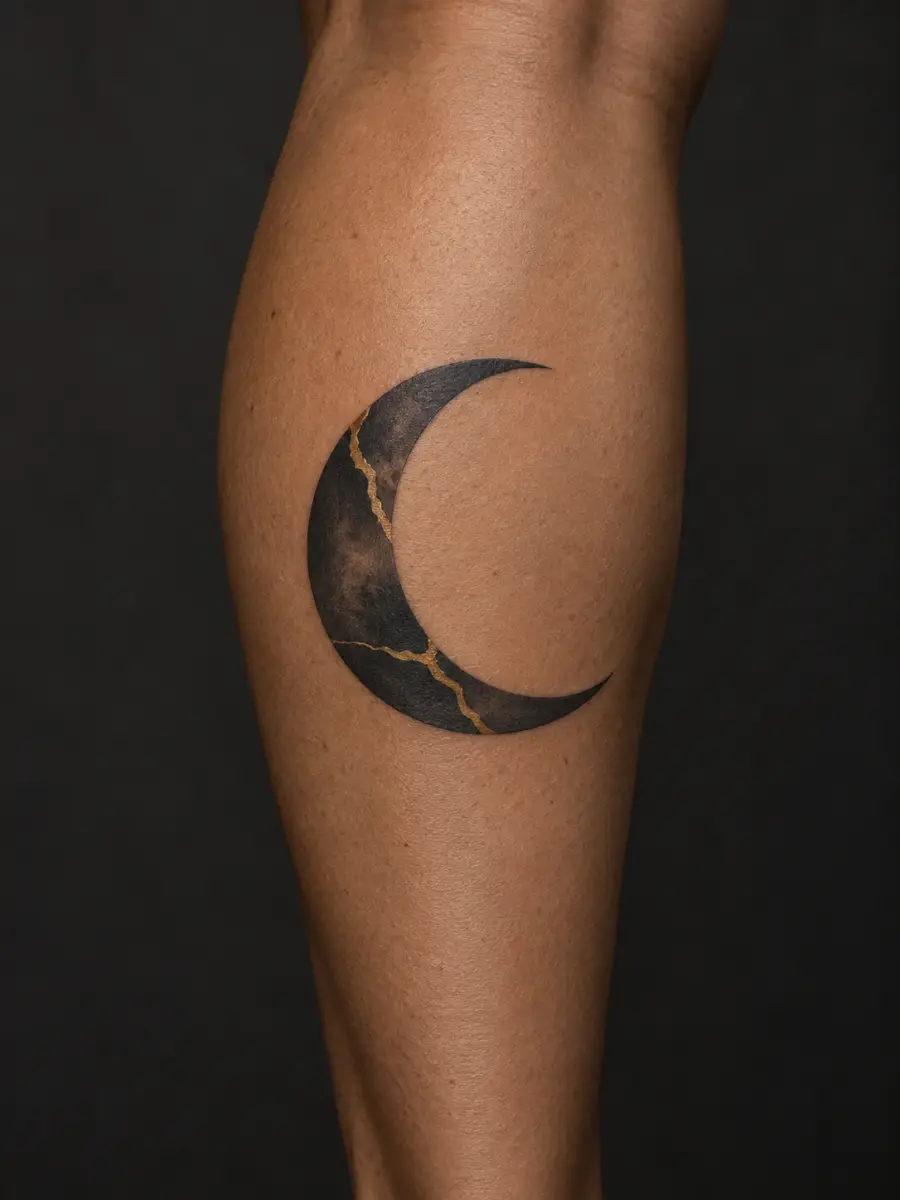
A dark crescent with a few warm seams is a quieter alternative to blue-and-white ornament. The outline remains the subject and the joins become accents. This is a modern visual interpretation: the moon is not a required kintsugi motif, and a line through a shape does not automatically carry a historical meaning.
For a calf or forearm, compare how much space the curve needs and whether the seam remains visible at the intended size. If you prefer an entirely black-and-grey tattoo, ask the artist how open gaps or changes in shading could suggest repaired pieces without a gold-colored finish.
Build your own design brief
A useful brief identifies the object, the treatment and what the artist can change. For example: “An original porcelain anatomical heart for my forearm, with sparse blue botanical ornament and a few warm gold-colored repair seams. Keep the silhouette clear. Please simplify detail for the final size and show the placement with my arm relaxed.” Add your preferred size and whether color is essential.
Ombra Tattoo offers a guided design flow with choices for idea, style, color, placement and size. Describe the kintsugi-inspired direction in your idea rather than assuming there is a dedicated kintsugi preset. The app is free to download; generation access depends on the in-app offer.
Explore your tattoo idea in OmbraBefore you book: settle the gold effect and final drawing
- Gold appearance: take the concept as a color reference and ask the artist how they would translate its highlights and shadows into ink. A bright AI highlight is not evidence of a reflective finish on skin.
- Readability: choose the important seams before adding ornament. Review the full design at the intended stencil size, not only as a magnified close-up.
- Artist reference: ask to see that artist’s relevant completed and healed work. The concepts on this page cannot demonstrate their technique or predict your result.
A rising search topic, not a newly invented tradition
In a Google Trends check on September 10, 2026, “kintsugi tattoo ideas” appeared at +80% in the rising related queries for “tattoo ideas,” using United States, Web Search and Past 90 days. Google defines this percentage relative to the preceding period. It is a dated discovery signal, not an absolute monthly search count, evidence of bookings or a forecast of Instagram reach. The craft and tattoo interpretations predate that observation.
Sources and reference context
FAQ
What is a kintsugi tattoo?
It is a contemporary tattoo interpretation of visible ceramic repair seams. Designs may depict repaired pottery or apply the same visual idea to a heart, moon or another personally chosen form.
Does a kintsugi tattoo have to be blue and gold?
No. Blue-and-white ornament suggests porcelain, but the pictured object can be plain. Black-and-grey shading or open gaps can also suggest joined fragments. Choose the treatment with your artist.
How do I ask for a gold effect in a kintsugi tattoo?
Show your artist the warm colors and light-dark contrast you like in a reference. Ask how they would interpret those details in ink and request examples of their relevant work. A reflective-looking AI image cannot show the healed appearance of a tattoo.
Can a kintsugi tattoo cover an old tattoo?
A kintsugi theme does not establish cover-up suitability. The existing ink, the new drawing and the placement need individual assessment by an artist. Thin repair lines alone are not a coverage plan.
Can I copy one of these concepts exactly?
Use our original AI concepts to explain what you like, then ask an artist for a drawing fitted to you. If you bring another artist’s tattoo as a reference, identify that artist and request an original interpretation.
Related guides
Ombra Tattoo
AI cover-up and design concepts