AI tattoo prompt
Updated
The Ombra Tattoo team · Written by the team behind the Ombra cover-up preview app — we look at real cover-up cases every day.
A useful AI tattoo prompt names one main subject, the tattoo style, the composition, the intended placement, the visual weight, and a short list of things to avoid. Describe relationships instead of stacking adjectives: say where the subject faces, what frames it, and which element should dominate. Generate a few controlled variations, change one decision at a time, and treat every result as a planning reference rather than tattoo-ready art.
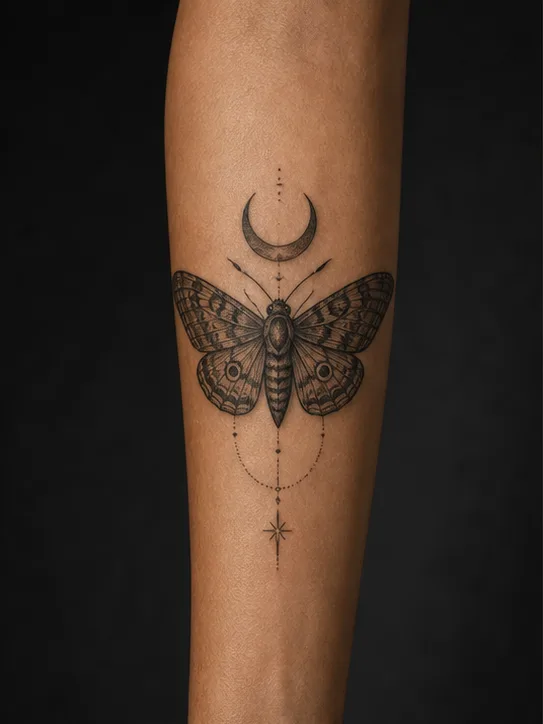
The best prompt is not the longest one. It gives the image system enough structure to make deliberate choices without dictating every line. A list such as “beautiful, unique, meaningful, cool tattoo” contains almost no visual instruction. A centered moth with open wings, a small crescent above it, fine blackwork, and enough open skin between the elements describes a composition you can actually judge.
Build the prompt in a fixed order
Name one main subject
Start with the visual anchor: moth, fox, peony, compass, pet portrait, serpent, or another concrete subject. If two subjects matter, state which one leads. Avoid asking five unrelated symbols to carry equal weight; the result usually becomes a collection of stickers rather than one tattoo composition.
Choose a style and line character
Specify a tattoo language such as blackwork, traditional, illustrative, fine line, ornamental, geometric, or black-and-grey realism. Add one useful qualifier—bold outline, delicate line, smooth shading, solid black, or restrained color—rather than mixing styles that solve opposite problems.
Describe the composition
Explain the arrangement: centered, vertical, wrapping, symmetrical, profile view, surrounded by leaves, or framed by an arch. Say what belongs above, below, behind, or around the subject. Composition words often improve the result more than decorative adjectives because they control how the parts relate.
Add the body area and approximate footprint
Name the intended surface and shape, for example a narrow vertical outer-forearm piece or a medium oval calf design. This does not guarantee anatomical fit, but it encourages an aspect ratio you can test. Keep exact centimetres for the artist conversation, where the real body can be measured.
Set contrast and detail priorities
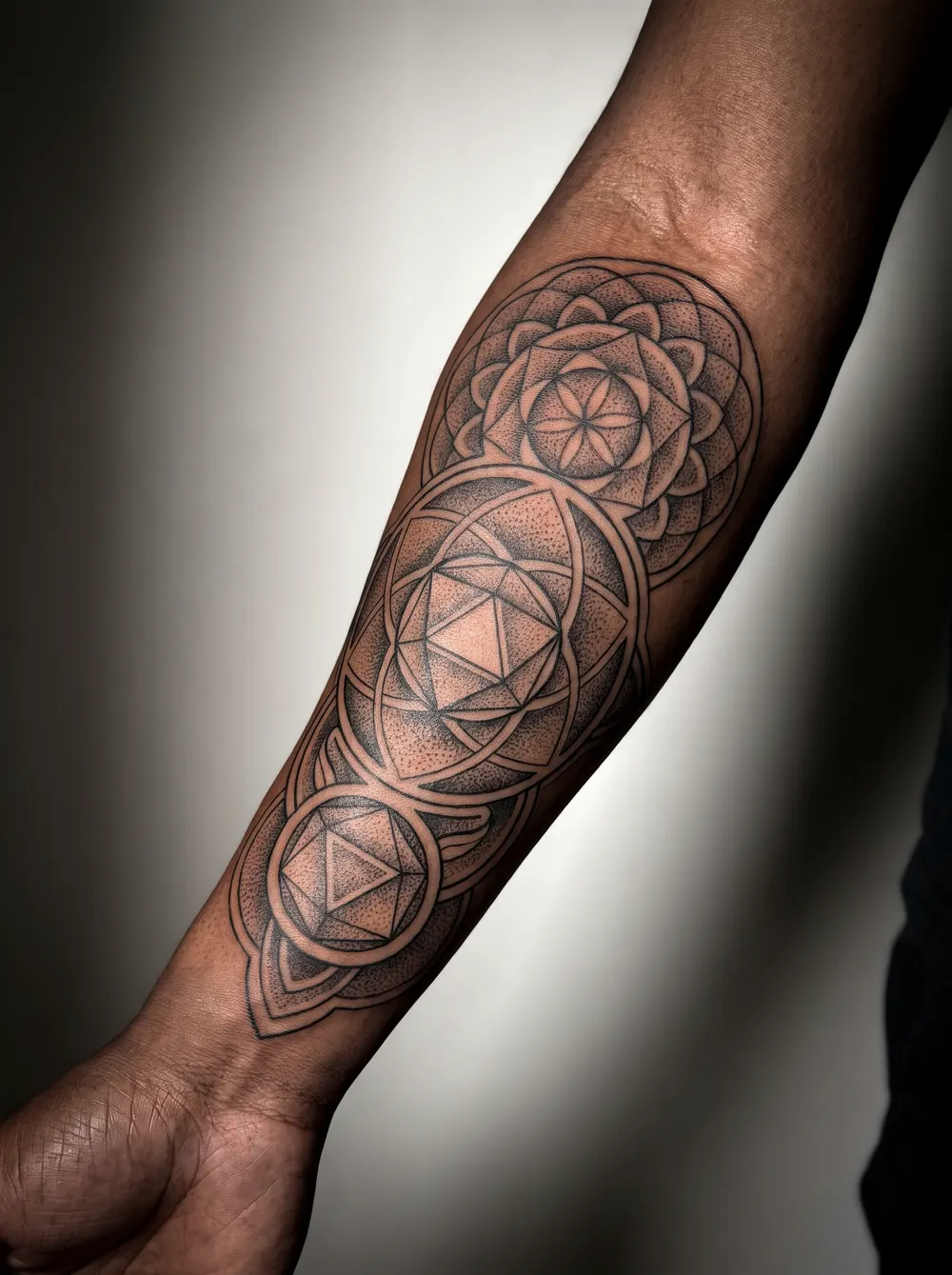
State whether you want strong readability from a distance, light negative space, a dark focal area, or limited micro-detail. Name the one detail that must survive simplification. If everything is described as intricate, the preview may look impressive on screen while becoming unsuitable at the intended size.
Finish with a short avoid list
Exclude only common failures relevant to your idea: no text, no extra symbols, no background scene, no jewelry, no second animal, or no heavy blackout. A huge negative list can compete with the actual design request. Keep it specific and check the result instead of assuming the instruction was followed perfectly.
Use a compact prompt formula
A practical formula is: main subject + style + arrangement + placement shape + contrast priority + exclusions. For example: “A symmetrical moth tattoo in fine blackwork, wings open, a small crescent centered above, vertical outer-forearm composition, clear negative space, no text or background scenery.” This is not a magic command. It is a stable brief that makes each generated variation comparable.
When the first result is close, revise one variable. Ask for a bolder silhouette without changing the subject, or a narrower footprint without adding new motifs. If you rewrite the style, composition, palette, and placement together, you cannot tell which change improved the idea. Save the promising versions and note what each one tested.
Turn a clear prompt into a tattoo direction → Get the appTurn the result into an artist brief
Do not hand an artist only the generated image and ask for an exact copy. Bring the prompt, the unedited body photo, two or three results, and a short note explaining what you like in each. Mark which elements are essential and which are experiments. This gives the artist room to correct anatomy, simplify detail, build an original composition, and fit it to your actual placement.
Ombra Tattoo is free to download and can help you test a prompt direction on your own photo in the app. Compare normal viewing size as well as a close crop. A version that reads clearly on the body is usually a more productive consultation reference than the most elaborate standalone image.
FAQ
How long should an AI tattoo prompt be?
Use enough words to define the subject, style, composition, placement shape, contrast, and key exclusions. Clear relationships matter more than length or a pile of adjectives.
Should I include the body placement in the prompt?
Yes. Naming the body area and footprint can guide the composition, but it does not replace measuring the real placement or an artist's anatomical adjustments.
Can I ask an AI to copy an existing tattoo?
Use references to communicate qualities, not to duplicate another artist's work. Ask your tattoo artist to create an original design from the direction.
Why does my prompt produce crowded designs?
Too many equal subjects, mixed styles, and repeated detail requests often create clutter. Choose one focal subject, remove secondary symbols, and ask for visible negative space.
Is an AI tattoo result ready to be tattooed?
No. It is a visual planning reference. A professional must redraw it for anatomy, scale, technique, originality, and how it should age.
Related guides
Ombra Tattoo
Preview ink on your own skin